The hammer pattern is one of the most popular reversal signals in trading, but on its own it’s not always reliable. That’s why traders combine it with hammer pattern indicators to improve accuracy and filter out false signals.
When used with tools like RSI, MACD, moving averages, and Bollinger Bands, the hammer becomes much more powerful. These indicators help confirm whether a potential reversal is real by showing momentum, trend direction, and volatility.
In this guide, you’ll learn how to use the hammer pattern with indicators to find stronger trade setups and avoid common mistakes.
Why Use Indicators with a Hammer Pattern
The hammer pattern shows a potential reversal, but it doesn’t guarantee one. Markets can stay bearish even after a hammer forms, which is why confirmation matters.
Using hammer pattern indicators helps traders avoid weak setups and focus only on high-probability trades. Indicators add context by showing momentum, trend strength, and market conditions.
For example, hammer RSI confirmation can reveal whether the market is oversold, increasing the chance of a bounce. Without that signal, the hammer might just be a temporary pause in a downtrend.
In simple terms, the hammer gives you a signal, while indicators help you decide whether to trust it.
Hammer + RSI Strategy
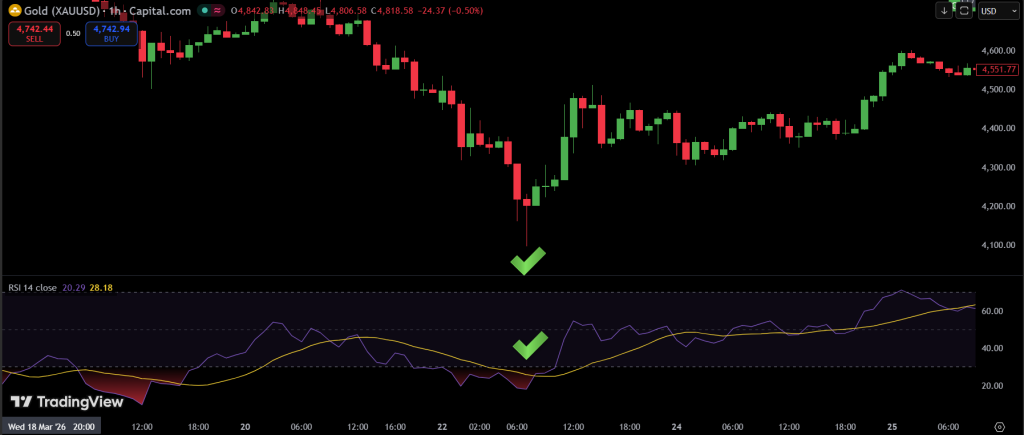
The RSI (Relative Strength Index) is one of the most effective tools for confirming a hammer pattern. It helps identify when the market is oversold, which increases the chances of a bullish reversal.
A strong setup appears when a hammer RSI signal forms while RSI is below 30. This suggests that selling pressure is exhausted and buyers may take control.
A simple hammer RSI strategy looks like this:
- Price forms a hammer after a downtrend
- RSI is in the oversold zone (below 30)
- The next candle closes higher, confirming the reversal
This type of hammer RSI confirmation filters out many false signals and improves entry timing.
For better results, watch for RSI divergence as well. If price makes a lower low but RSI makes a higher low, the reversal signal becomes even stronger.
Hammer + MACD Confirmation
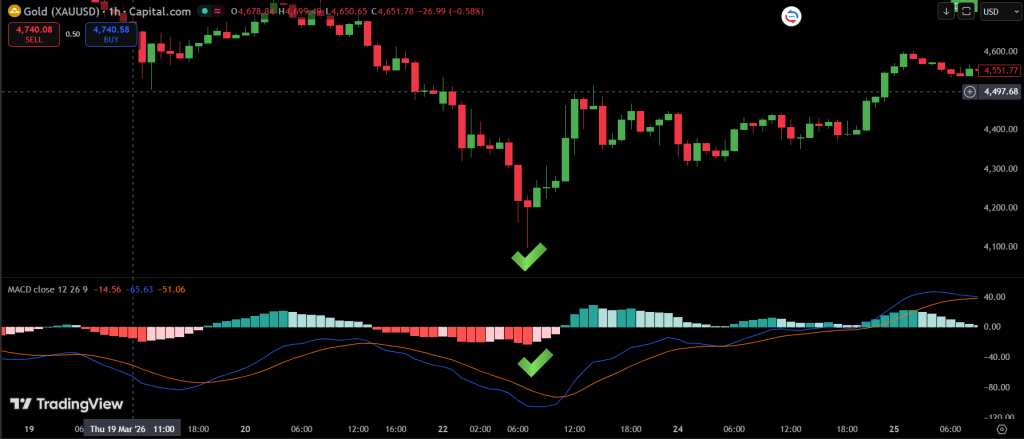
The MACD (Moving Average Convergence Divergence) helps confirm whether momentum is shifting after a hammer pattern appears. While the hammer shows a potential reversal, MACD tells you if the market is actually starting to turn.
A solid hammer MACD setup usually includes one of these signals:
- MACD line crossing above the signal line
- Histogram changing from negative to positive
- Bullish divergence between price and MACD
For example, if a hammer forms after a downtrend and the MACD histogram starts rising, it suggests that bearish momentum is fading. This increases the probability of a bullish move.
The key idea is simple: the hammer shows rejection of lower prices, and MACD confirms that momentum is shifting in favor of buyers.
Hammer + Moving Average Strategy
Moving averages help you identify the main trend, which is important when trading the hammer pattern. A hammer is much more reliable when it appears in line with a broader bullish context or at a key dynamic level.
In a hammer moving average strategy, traders often look for price reacting near a moving average and then forming a hammer as a reversal signal.
A common approach includes:
- Price is in a downtrend and approaches a key MA
- A hammer forms near that level
- Price breaks above the hammer high for confirmation
Hammer + SMA Strategy
The hammer SMA strategy focuses on simple moving averages (like SMA 50 or SMA 200). If a hammer forms near these levels, it can signal strong support and a possible reversal.
Hammer + EMA Strategy
The hammer EMA strategy uses exponential moving averages, which react faster to price changes. EMAs (like EMA 20 or EMA 50) often act as dynamic support in trends.
Hammer + Bollinger Bands Strategy
Bollinger Bands help traders understand volatility and identify when price is stretched too far. When combined with the hammer pattern, they can highlight strong reversal zones.
A typical hammer bollinger bands setup appears when price touches or moves below the lower band and then forms a hammer candle. This often signals that selling pressure is overextended and a bounce may follow.
A simple approach looks like this:
- Price hits the lower Bollinger Band
- A hammer pattern forms at or near that level
- Price closes back inside the bands for confirmation
In this context, Bollinger Bands act as a “distance check”, they show when price is statistically far from its average, while the hammer confirms rejection of lower levels.
This combination works best in volatile markets where price frequently overreacts before reversing.
Best Tips for Trading Hammer with Indicators
Trading the hammer pattern indicators combination works best when you keep it simple and focus on confirmation, not prediction.
First, don’t trade every hammer you see. The pattern is only useful when it appears in the right context — after a clear downtrend or at a key support level.
Second, always combine signals. A hammer alone is weak, but a hammer with RSI, MACD, or a moving average strategy becomes much more reliable.
Third, avoid overloading your chart. Using too many indicators like RSI, MACD, and Bollinger Bands at the same time can create confusion instead of clarity.
Finally, wait for confirmation. A strong setup usually needs a follow-up bullish candle after the hammer before entering a trade.
Common Mistakes to Avoid
Many traders lose money with the hammer pattern because they treat it as a standalone signal. Without confirmation from indicators, it often leads to weak or false entries.
Here are the most common mistakes to avoid when trading the hammer pattern indicators setup:
- Trading every hammer without trend context
- Ignoring hammer RSI confirmation and overbought/oversold zones
- Entering trades without hammer MACD or momentum confirmation
- Misusing hammer moving average strategy in sideways markets
- Relying only on the candle and ignoring volume or volatility
- Using too many indicators at once and overcomplicating decisions
Keeping your approach simple and focused on confirmation will significantly improve your results.
Conclusion
The hammer pattern becomes much more effective when it’s combined with indicators instead of being used alone. Tools like RSI, MACD, moving averages, and Bollinger Bands help confirm whether a reversal is actually likely or just noise.
In practice, the best results come from keeping things simple, using hammer pattern indicators for confirmation, not prediction. Focus on clear setups, wait for confirmation, and avoid overtrading.
FAQ
What indicators work best with a hammer pattern?
RSI, MACD, moving averages, and Bollinger Bands are the most commonly used tools for confirmation.
Is RSI useful for hammer confirmation?
Yes, especially when RSI is below 30, showing oversold conditions.
Can MACD confirm a hammer signal?
Yes, MACD helps confirm momentum shift through crossovers or histogram changes.
Which moving averages are best for hammer strategy?
SMA 50, SMA 200, EMA 20, and EMA 50 are commonly used levels.
Are Bollinger Bands useful with hammer patterns?
Yes, they help identify overextended price moves and potential reversal zones.


