

A scalper enters and exits a trade in seconds. A swing trader holds for weeks. One relies on algorithms; another trusts intuition. Despite their differences, both operate within a framework, whether they realize it or not. This is the essence of what are trading strategies: structured methods that define entry, exit, and risk management rules.
The problem is that most traders learn in fragments. They pick up “head and shoulders” here, “breakout” there, yet never see how these pieces connect. The result is a toolbox full of tactics but no blueprint for understanding all about trading strategies, how they relate, where they conflict, and which suit different market conditions.
This article provides that blueprint. We strip away the noise and organize the common trading strategies into a clear taxonomy. You will learn how strategies differ by methodology (systematic vs. discretionary), market behavior (trend following vs. mean reversion), and structure. No fluff. Just a framework to navigate the complex landscape of trading strategies with clarity and purpose.
Why Classify Trading Strategies?
Without classification, a trader treats every market situation the same. They chase a momentum strategy during a range-bound market or apply mean reversion logic to a strong trend. The result is inconsistency. Understanding trading strategies and principles allows traders to match the right approach to the right market condition. This transforms randomness into a repeatable process.
Classification also builds the foundation for risk management. A portfolio built on ten variations of trend following is not diversified. It is concentrated risk. By grouping strategies by their core logic, traders can combine uncorrelated approaches, such as pairing a momentum system with a mean reversion system. This separation of trading strategies and tactics ensures that when one approach struggles, others may thrive, creating stability across market cycles.
Level 1: Classification by Methodology
Every trading strategy begins with a single question: who makes the decision, a human or a machine? The answer creates the most fundamental divide in the classification of trading strategies. This split separates the objective, rule based world of systematic trading from the subjective, experience driven realm of discretionary trading. Understanding this distinction is essential before exploring any specific approach.
Systematic vs. Discretionary Trading
Systematic trading operates on rules. Every entry, exit, and position size is predetermined and often automated. There is no room for hesitation or gut feeling. This approach, often called quantitative trading, relies on backtesting, statistical analysis, and historical data to validate performance. The goal is to remove emotion entirely. Within this category, quantitative vs qualitative strategies take shape through algorithms and mathematical models rather than intuition.
Discretionary trading takes the opposite path. The trader makes decisions in real time based on experience, market context, and intuition. A discretionary trader may see a pattern that does not fit a strict rule set but feels familiar from years of screen time. This approach values adaptability over automation. The tension between systematic vs discretionary trading ultimately comes down to whether a trader trusts hard coded rules or human judgment to navigate the markets.
Level 2: Classification by Market Behavior & Logic
Price movement is not random, but it follows patterns. Some traders ride the wave. Others bet against it. This section breaks down the different trading strategies based on how they interpret and interact with market behavior. Each approach operates on a distinct logic, and understanding these differences is what separates strategic trading from guesswork.
Trend Following Strategies
The oldest adage in trading holds that the trend is your friend. Trend following strategies operate on this principle. They aim to capture sustained directional moves by entering when momentum establishes itself and exiting when the trend shows signs of exhaustion. Common tools include moving average crossovers and trendline breaks. The core debate of trend following vs mean reversion begins here: one group chases momentum while the other waits for exhaustion. Within this category, breakout vs reversal strategies often intersect, as trend followers typically enter on breakouts of key levels.
Example: Moving Average Crossover
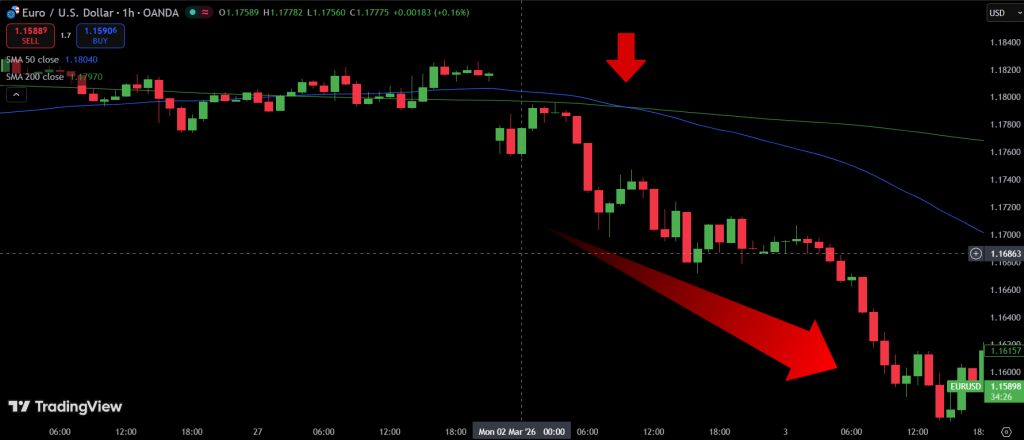
A buy signal occurs when the 50 period SMA crosses above the 200 period SMA. A sell signal occurs when the 50 period SMA crosses below the 200 period SMA.
Mean Reversion Strategies
Mean reversion strategies operate on a different assumption. They hold that price moves in cycles and that extreme spikes will eventually return to the average. When an asset becomes overextended, a mean reversion trader bets on the pullback. Tools like the Relative Strength Index and Bollinger Bands help identify these extremes. This approach directly opposes trend following in the trend following vs mean reversion framework. It thrives in range bound strategies, where price oscillates between support and resistance without forming a clear directional bias.
Example: RSI Oversold Bounce
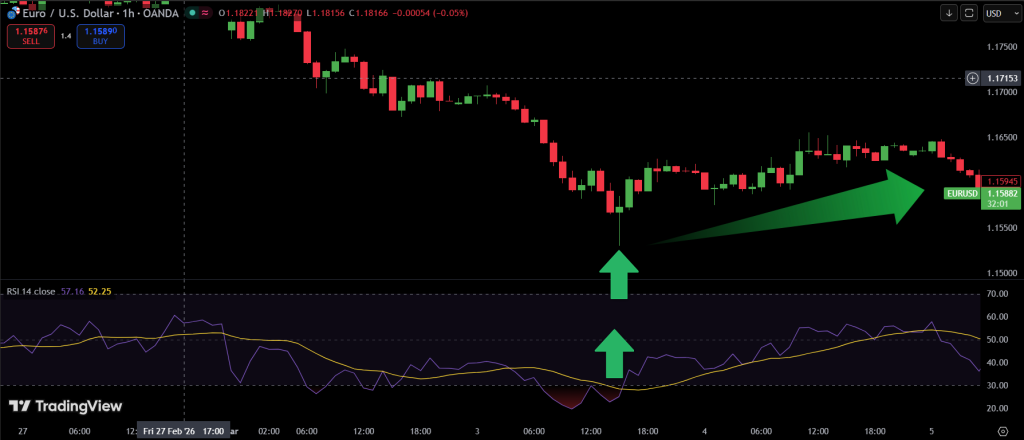
When the RSI drops below 30, the asset is considered oversold. The trader enters a buy position expecting price to revert upward. The exit occurs when the RSI returns above 50.
Momentum vs. Contrarian
The momentum vs contrarian divide cuts across both trend following and mean reversion. Momentum traders buy what is already rising. They believe strength begets strength and that recent winners will continue to outperform. Contrarian traders take the opposite stance. They buy underperforming assets, betting that current sentiment has overshot reality and that a reversal is imminent. While momentum aligns with trend following, contrarian logic often overlaps with mean reversion, creating a layered framework for interpreting market psychology.
Example: 20 Day High Momentum
A momentum strategy buys when price breaks above the 20 day high. The logic is that breaking a recent high signals continued strength. The trader holds until price closes below the 10 day moving average.
Example: 20 Day Low Contrarian
A contrarian strategy buys when price drops below the 20 day low. The logic is that the selloff is overdone and a bounce is likely. The trader holds until price returns to the 20 day moving average.
Breakout vs. Reversal
The distinction between breakout vs reversal strategies lies in how a trader interprets price structure. Breakout strategies target moments when price exits a defined consolidation range. The logic is that pent up energy releases in a sustained move. Reversal strategies target turning points. They look for signs that an existing trend is ending, such as divergence or candlestick patterns. Both approaches aim to enter at the beginning of a move, but one bets on continuation while the other bets on exhaustion. Together, they represent two sides of breakout vs reversal strategies in the broader classification of trading strategies.
Example: Range Breakout
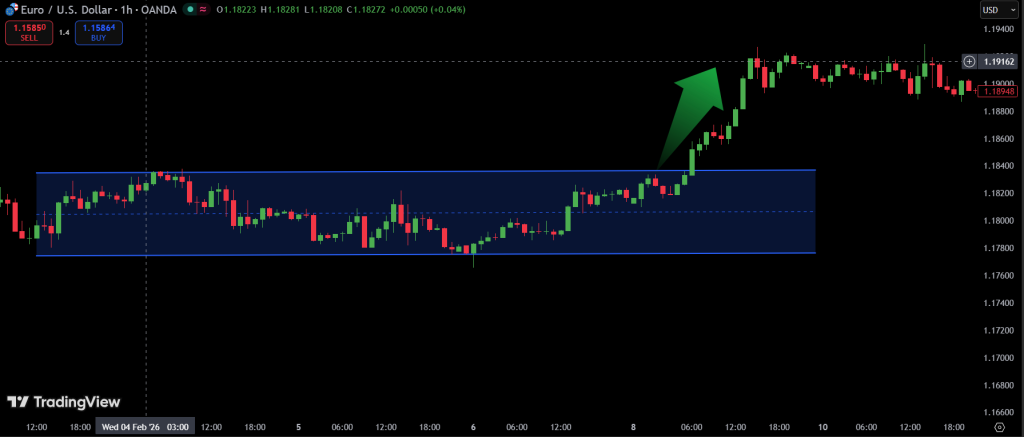
A breakout strategy identifies a consolidation range with clear support and resistance. A buy signal occurs when price closes above resistance with strong volume. The stop loss is placed below support.
Level 3: Classification by Timeframe
Not all traders look at the same chart. A scalper measures life in seconds. A position trader thinks in months. Timeframe is one of the most practical ways to organize the 5 types of trading strategies, as it dictates everything from position sizing to psychological demands. Understanding these categories helps traders identify which style aligns with their schedule, risk tolerance, and personality.
Scalping
Scalping is the fastest approach in the list of trading strategies. Trades last seconds to minutes, sometimes holding only as long as it takes for a brief imbalance to resolve. Scalpers rely on high frequency execution, tight spreads, and razor thin profit targets. The goal is not to capture large moves but to accumulate small gains across hundreds of trades. This style requires intense focus and is best suited for traders who thrive on speed and screen time.
Day Trading
Day trading sits one step above scalping in the 4 types of trading strategies based on duration. Positions are opened and closed within the same trading session. No position is held overnight. This eliminates gap risk and allows traders to start fresh each day. Day traders use intraday charts, volume profiles, and level 2 data to identify short term opportunities. The style demands discipline, as losses can compound quickly without strict risk management.
Swing Trading
Swing trading captures moves that unfold over days to weeks. The goal is to ride a market swing from one pivot point to the next. This approach sits in the middle of the types of Forex strategies timeline, offering a balance between frequency and position size. Swing traders use daily and 4 hour charts, relying on technical patterns, support and resistance, and momentum indicators. The slower pace allows for more flexibility, making it a popular entry point for newer traders.
Position Trading
Position trading extends the holding period to weeks or months. This style aligns with long term trend following, where traders ignore short term noise and focus on the broader directional move. Position traders use weekly and daily charts, often combining technical analysis with fundamental factors. The approach requires patience, as positions may endure pullbacks without triggering exits. Among the 5 types of trading strategies, position trading demands the least screen time but the highest conviction.
Investing vs. Trading
Investing is often grouped with trading but operates on a different logic. Where trading seeks to profit from price fluctuations, investing aims to build wealth through long term ownership and compounding. Investors hold positions for years, focusing on fundamentals, business models, and economic cycles. While not a trading strategy in the strict sense, understanding the distinction helps traders avoid confusing short term tactics with long term commitments. Together, these five categories form a complete list of trading strategies organized by the one variable every trader must define first: time.
Comparative Table: Trading Strategies by Timeframe
| Strategy | Time Horizon | Typical Hold Time | Charts Used | Key Trait |
|---|---|---|---|---|
| Scalping | Seconds to minutes | Seconds to a few minutes | Tick charts, 1 minute | Speed, high frequency |
| Day Trading | Intraday | Minutes to hours | 5 minute, 15 minute, 1 hour | No overnight risk |
| Swing Trading | Days to weeks | 2 to 20 days | 4 hour, daily | Captures market swings |
| Position Trading | Weeks to months | 1 to 6 months | Daily, weekly | Follows long term trends |
| Investing | Years | 3+ years | Weekly, monthly | Fundamental driven, compounding |
Level 4: Classification by Asset Class & Specific Techniques
Beyond methodology and timeframe lies another layer of distinction: what you trade and how you structure the trade itself. Some strategies are native to specific markets, while others transcend asset classes through unique structural approaches. This section covers the names of forex strategies, directional bets, arbitrage techniques, and event driven plays that round out the complete classification of trading strategies.
Forex Specific Strategies
The forex market operates 24 hours a day with unparalleled liquidity. This unique environment has given rise to types of forex strategies that differ from equity or commodity trading. Among the most common forex strategies, three stand out for their distinct logic and widespread use.
Carry Trade
A carry trade involves borrowing a currency with a low interest rate and buying a currency with a high interest rate. The trader profits from the interest rate differential while hoping the exchange rate remains stable or moves in their favor. This is one of the oldest popular forex strategies among institutional traders.
Breakout Trading on Currency Pairs
Forex pairs often trade in ranges during certain sessions and break out during others. Breakout traders identify key support and resistance levels, entering when price breaks through with momentum. This approach is common in the list of forex strategies due to the clear levels formed by daily and weekly sessions.
News Trading
Economic releases such as non farm payrolls, interest rate decisions, and CPI data create rapid spikes in currency pairs. News traders attempt to capitalize on these spikes by entering positions within seconds of the release. This high risk approach requires fast execution and a deep understanding of market expectations.
Directional vs. Non-Directional Strategies
Every trade either bets on direction or attempts to profit regardless of where price moves. This split defines the directional vs non-directional strategies framework.
Directional Strategies
Directional strategies take a simple stance: price will go up or price will go down. Long positions profit from rising markets. Short positions profit from falling markets. Trend following, breakout trading, and momentum strategies all fall into this category. The trader’s success depends entirely on correctly predicting the direction of movement.
Non-Directional Strategies
Non-directional strategies aim to profit from volatility, relative pricing, or time decay without forecasting direction. These approaches include options strategies like straddles and strangles, as well as pairs trading and market making. The trader profits from the magnitude of movement or the relationship between assets, not from picking a side on the broader market.
Arbitrage & Market Making
Arbitrage and market making represent the most quantitative and institutional end of the classification of trading strategies. These approaches focus on inefficiencies and liquidity provision rather than price prediction.
Statistical Arbitrage
Statistical arbitrage uses quantitative models to identify mispricings between related assets. The trader takes offsetting positions, betting that the pricing anomaly will converge. These strategies rely on complex algorithms, high frequency data, and rigorous backtesting. Statistical arbitrage is a core component of modern hedge fund strategies.
Pairs Trading
Pairs trading is a specific form of statistical arbitrage involving two highly correlated assets. When the spread between them widens beyond historical norms, the trader buys the underperforming asset and shorts the outperforming one. The position profits when the spread returns to its mean. Pairs trading is market neutral, meaning overall market direction has little impact on performance.
Market Making
Market making involves providing liquidity by simultaneously quoting a bid price and an ask price. The market maker profits from the spread, capturing small profits on each transaction. This is one of the oldest arbitrage strategies, though modern market making relies heavily on algorithms and co location. Market making strategies require high volume, low latency, and precise risk management.
Event-Driven & Macro Strategies
The final layer of classification focuses on catalysts beyond technical patterns. Event-driven strategies and macro strategies rely on fundamental analysis and anticipation of external forces.
Event-Driven Strategies
Event-driven strategies capitalize on corporate events that create pricing dislocations. Mergers, acquisitions, earnings releases, and spin offs all fall into this category. Merger arbitrage, for example, involves buying the target company and shorting the acquirer after a deal announcement, betting on the spread narrowing as the deal closes. These event-driven strategies require deep knowledge of corporate law and deal mechanics.
Macro Strategies
Macro strategies take the broadest view in the classification of trading strategies. Traders analyze economic trends, interest rate policies, geopolitical events, and global capital flows. A macro trader might short a currency ahead of a central bank rate cut or buy commodities during a period of fiscal expansion. Macro strategies often combine multiple asset classes and hold positions for months or years, making them a distinct category separate from technical or purely quantitative approaches.
Conclusion
We have covered a wide landscape. Starting with the foundational divide of systematic vs discretionary trading, we moved through market behavior classifications like trend following and mean reversion, then organized strategies by timeframe, and finally explored asset class specific techniques such as pairs trading and market making. This hierarchy is not just academic. It is a practical tool for understanding where any given approach fits and how it behaves across different market conditions.
So where do you begin? The right strategy is not about what worked for someone else. It is about alignment with your own personality, schedule, and risk tolerance. Do you thrive on speed and screen time? Scalping or day trading may suit you. Do you prefer patience and fewer decisions? Swing trading or position trading could be a better fit. Are you drawn to statistical models and relative value? Pairs trading or statistical arbitrage might be your path. The all trading strategies available today can be mapped against your personal traits to find the style you can execute consistently.
No single strategy is the best. A trend following system that excels in a strong bull market will bleed in a choppy, range bound environment. A mean reversion approach that profits from volatility spikes will struggle during sustained directional moves. Understanding the trading strategies tier list is not about ranking them as good or bad. It is about knowing which strategy belongs in which market condition and how to combine uncorrelated approaches for stability. This taxonomy gives you the framework to build a diversified portfolio of strategies, manage risk across cycles, and trade with clarity instead of noise.
Summary Table: Trading Strategies Taxonomy
| Classification Layer | Categories | Key Approaches |
|---|---|---|
| Methodology | Systematic vs. Discretionary | Quantitative, automated, rule based vs. human judgment, intuition |
| Market Behavior | Trend Following vs. Mean Reversion | Moving average crossovers, breakout vs. RSI oversold, range bound |
| Market Behavior | Momentum vs. Contrarian | 20 day high breakout vs. 20 day low bounce |
| Market Behavior | Breakout vs. Reversal | Range breakout, SMA 50 breakout vs. double bottom, head and shoulders |
| Timeframe | 5 Types | Scalping, day trading, swing trading, position trading, investing |
| Asset Class & Techniques | Forex Specific | Carry trade, breakout on currency pairs, news trading |
| Asset Class & Techniques | Directional vs. Non-Directional | Long/short directional bets vs. volatility, pairs trading, market neutral |
| Asset Class & Techniques | Arbitrage & Market Making | Statistical arbitrage, pairs trading, market making |
| Asset Class & Techniques | Event-Driven & Macro | Merger arbitrage, earnings plays, interest rate strategies, geopolitical trades |
FAQ
What are the 4 types of trading strategies?
Based on duration and style, the 4 main types are Scalping, Day Trading, Swing Trading, and Position Trading. Based on market logic, they are Trend Following, Mean Reversion, Breakout, and Arbitrage. When someone asks to mention 4 trading strategies you know, these categories provide a complete answer that covers both timeframe and underlying logic.
What is the difference between systematic vs discretionary trading?
Systematic trading relies on automated algorithms, backtesting, and quantitative models. Every rule is predefined and executed without emotion. Discretionary trading relies on human experience, intuition, and real time judgment. The trader adapts to changing market conditions based on pattern recognition and market feel.
What is the most common forex strategy?
Trend following and breakout strategies are among the most common forex strategies due to the high liquidity and strong trending nature of major currency pairs like EUR/USD and USD/JPY. These strategies align with the 24 hour nature of forex and the clear levels formed by daily and weekly sessions.
Is fundamental analysis better than technical analysis?
It depends on the timeframe and the trader’s goals. Fundamental vs technical vs sentiment analysis each offer different advantages. Fundamentals explain the underlying drivers of value and work best for long term positioning. Technicals provide precise entry and exit timing for short to medium term trades. Sentiment analysis gauges crowd positioning and can signal potential reversals. The most effective approach often combines all three.
What are range bound strategies?
Range bound strategies involve buying at support and selling at resistance when the market is trading sideways without a clear trend. These strategies use oscillators like RSI and Stochastic to identify overbought and oversold conditions. They are the opposite of trend following strategies and perform best in choppy, consolidating markets.
What are the different trading strategies available to retail traders?
The different trading strategies available range from simple moving average crossovers to complex statistical arbitrage. Retail traders typically focus on trend following, mean reversion, breakout trading, and swing trading due to lower capital requirements and accessibility. More advanced strategies like market making and high frequency trading are generally reserved for institutional players.
What is a trading strategies tier list?
A trading strategies tier list is not about ranking strategies as universally good or bad. It is about matching strategies to market conditions. Trend following ranks highest in strong trending markets. Mean reversion ranks highest in ranging markets. Arbitrage strategies rank highest when pricing inefficiencies appear. The best traders maintain a portfolio of strategies and deploy the right one for the current environment.
What are common trading strategies for beginners?
Common trading strategies for beginners include swing trading with moving averages, breakout trading with support and resistance levels, and mean reversion with RSI. These approaches offer clear rules, manageable timeframes, and do not require advanced infrastructure or high speed execution.
What are all trading strategies based on?
All trading strategies are built on three core pillars: methodology (systematic or discretionary), market behavior (trend following, mean reversion, breakout, reversal), and timeframe (scalping to position trading). Understanding this structure allows traders to categorize any approach and assess its suitability for their goals.
What are the names of forex strategies?
The names of forex strategies include carry trade, breakout trading, news trading, trend following on major pairs, range trading, and price action strategies like pin bars and inside bars. Each approach suits different market conditions and trader personalities.


